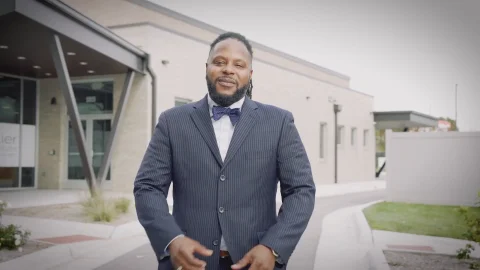
Dr. Heatrice on Treating Cases Other Surgeons Turn Away
Some patients arrive at Premier Institute of Oral & Facial Surgery having already been told no somewhere else. Dr. Alexander Heatrice joined Studio STL to talk about his path into surgery, why he went out of his way to train in techniques most practices do not offer, and what it means to build a practice around the cases other offices turn away. The conversation is below, lightly edited for length and clarity, with additional context added.
From Oklahoma to the Military to Oral Surgery
Studio STL: How did you get into oral surgery?
Dr. Heatrice: I grew up in Oklahoma City. I went to undergrad at the University of Oklahoma, and from there I went to dental school. After that I went into the military and served our country for seven years. During that time serving, I realized I wanted to be a surgeon. I was able to go to a residency program at Harlem Hospital Center in New York City, an affiliate of Columbia University Medical Center, and at that point I knew this is what I want to do.
The military years are not incidental to how he practices. Dentists serving in the armed forces treat a patient population that arrives with problems already in progress rather than caught early at routine cleanings, and often under conditions that require making decisions with what is available. That is a different formative experience than a purely civilian path.
Oral and maxillofacial surgery residency is a hospital-based program covering anesthesia, trauma, pathology, and reconstructive surgery of the face and jaws, well beyond dental extractions. Harlem Hospital Center, where he trained, is a Columbia University Medical Center affiliate serving a large urban population, which means high case volume and considerable complexity.
Read Dr. Heatrice’s full background, training, and credentials on the Meet Dr. Heatrice page.
Building the Practice Around Comfort
Studio STL: Tell us about Premier Institute. What sets you apart?
Dr. Heatrice: One of the things is we provide a patient experience with comfort. We want our patients to feel comfortable being in our office, because coming to an oral surgeon, people get anxiety. They get scared. Our goal is to provide them some type of comfort. And on top of that, we have strong technology in the field when it comes to oral surgery. So technology, patient satisfaction, and comfort all tie in together.
He connects those three deliberately rather than listing them separately. Technology contributes to comfort in a way that is easy to miss: when a procedure is planned in advance from three-dimensional imaging, the surgeon knows before the appointment where the bone is, where the nerves run, and what the plan is. Less is being figured out in the chair. Fewer surprises translates into shorter, more predictable appointments, which is a comfort question as much as a clinical one.
Dr. Heatrice goes into detail about the technology in a separate segment on advances in oral surgery.
What Patients Have Usually Been Told Before They Arrive
Studio STL: You are especially known for advanced dental implant procedures. Tell us more about that and the transformations you are able to provide.
Dr. Heatrice: People come to our office embarrassed and self-conscious. There are certain aspects of their lives where they are just hurting. One of the reasons is that they have been stuck in a denture all their lives, or they have been to someone who told them there is nothing we can do for you, you do not have enough bone.
The bone question is the one that stops most of these cases. When teeth are lost, the bone that held them begins to resorb, because that bone existed to support the roots and no longer has a job to do. The longer teeth have been missing, the less bone remains. In the upper jaw the problem compounds, because the maxillary sinuses tend to expand downward into the space as the ridge below them thins.
A conventional implant needs a certain volume of bone to anchor into. When it is not there, the standard answers are to build bone through grafting, or to decline the case. Grafting works well in many situations and it is a routine part of implant practice. But it adds surgical stages and healing time, and in cases of severe resorption there may not be enough remaining foundation to graft onto predictably.
For patients whose bone loss is moderate, bone grafting is often the right path, including sinus lift and ridge augmentation procedures.
Why He Sought Out Advanced Training
Dr. Heatrice: What we have done at Premier is that I went out and sought out the best surgeons in our specialty to learn the techniques. One of those techniques is zygomatic implants, where we can take implants from your mouth all the way up to your cheekbone.
That last sentence describes a genuinely different approach. Rather than rebuilding the deficient upper jaw, a zygomatic implant is considerably longer than a conventional one and anchors into the zygoma, the cheekbone. The zygomatic bone is dense and, importantly, it does not resorb when teeth are lost, because it never supported them in the first place. It is still there regardless of how long the patient has been without teeth.
This is not a routine procedure and it is not offered everywhere. It requires specific training and the imaging and planning capability to place a long implant accurately through a region of the facial skeleton where precision is not optional. His point about seeking out the surgeons who do this work is the operative detail.
Learn more on our zygomatic implants page.
Reaching Patients Other Practices Couldn’t Help
Dr. Heatrice: Also, if you do not have enough bone in the anterior ridge of your jaw, I can place an implant from there up toward the nose. Those types of implants give us the opportunity to reach people who could not be helped otherwise, so they can go out and enjoy their way of life by finding a surgeon who knows how to take on complicated cases.
The anterior ridge is the front of the jaw, where bone loss is often most pronounced and most visible. The approach he describes engages bone in the nasal region to gain anchorage where the ridge itself cannot provide it. Like the zygomatic approach, the logic is to find sound bone elsewhere rather than attempt to rebuild bone that is largely gone.
Together these techniques change the answer for a specific group of patients: those with severe upper jaw bone loss who have been told that grafting is not viable or that they should simply continue with dentures. They are not first-line treatment and they are not appropriate for everyone. For the patients who need them, they are frequently the difference between fixed teeth and no option at all.
Learn more on our trans-nasal implants page. Patients with adequate or moderately reduced bone are usually better served by standard All-on-4 treatment.
What the Transformation Looks Like
Studio STL: How does it feel to have that impact?
Dr. Heatrice: The transformation is one of the most rewarding experiences any surgeon can have. I do not care what surgeon you are. If you are able to help change someone’s life for the better, they come to you and they become part of your family. I have patients who will come and bat for Premier. They are our biggest spokespeople. They know what we have done to change their lives.
For patients in this category the change tends to be larger than for a routine implant case, because the starting point is further back. Someone who has spent years in a denture that does not stay in place, avoiding certain foods and certain situations, is not comparing a good outcome to an average one. They are comparing it to having given up on the problem.
Hear from patients on our patient testimonials page.
What He Wants Patients to Know
Studio STL: What is something you want patients who do not know about Premier to know?
Dr. Heatrice: I want them to know that we care. When you come to our office, you will see the love and support you have when you walk in. And not only when you walk in. You will get a surgeon who knows what they are doing. So you are getting love, support, and also a skill that will help you in the future.
If you have been told previously that nothing can be done, that assessment was made with a particular set of options in mind. A consultation with imaging is what determines whether it still holds.
Ask About Advanced Implant Options
If you have been told you are not a candidate because of bone loss, a consultation can tell you whether these techniques apply to your situation.